Disease testing through Canola Diagnostic Services can confirm which diseases are present in a field, but knowing how to act on them can be challenging. The real value of diagnostic testing is understanding what those results mean and using that information to make informed management decisions to protect future canola crops.
Blackleg and Verticillium
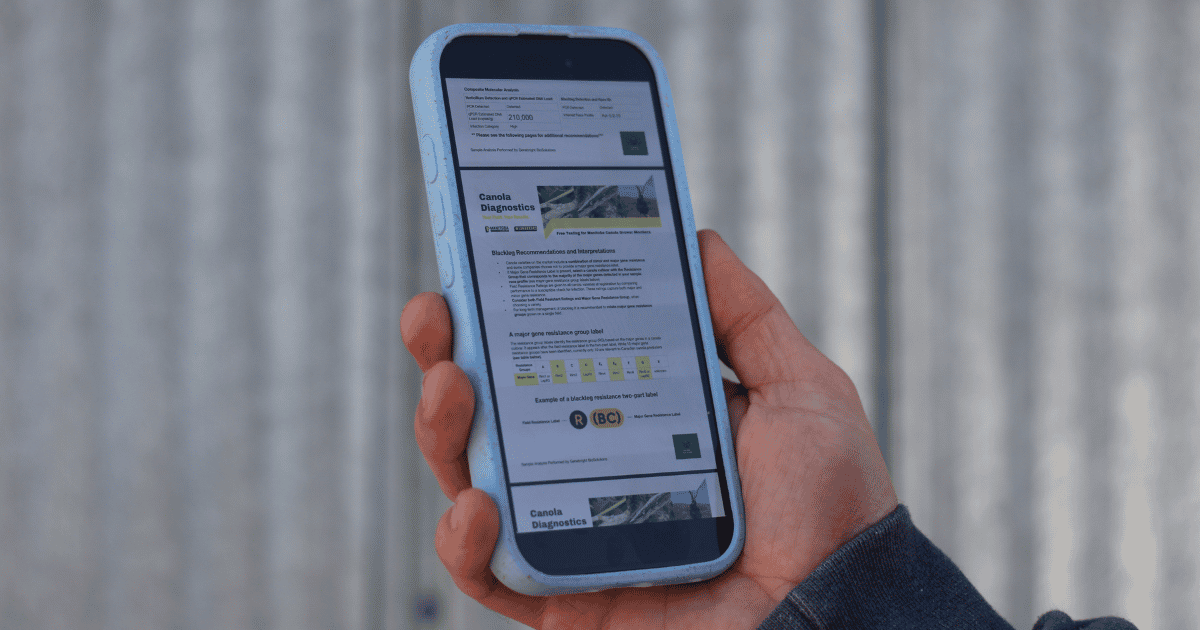
In Manitoba Canola Growers’ Diagnostic Testing, blackleg and verticillium stripe results are combined into a single report. For each stem analyzed, the report indicates whether blackleg and verticillium stripe were detected.
For verticillium stripe, the report includes an estimated DNA load and an infection category. DNA load reflects the amount of pathogen DNA detected in the sample and can vary depending on plant maturity at sampling. The infection category provides a general indication of disease presence, but it cannot be linked directly to yield loss as the relationship between infection and yield loss is still being researched.
For blackleg, the inferred race profile detected is reported. This is the mix of the blackleg pathogen populations that are present across all stems provided.
Using Your Blackleg and Verticillium Results
Start by reviewing the field’s history. Where were symptoms observed during the season? What variety was grown, and how did its disease ratings align with what was found in the field?
For verticillium stripe, management options are currently limited. Some seed companies provide internal tolerance ratings based on field observations, which can help direct future variety selection.
For blackleg, use the inferred race profile to select a variety with resistance to the blackleg races present in your field. Look for a variety that has the Resistance Group that contains a Major Gene that matches one of the Avr genes identified in your results.
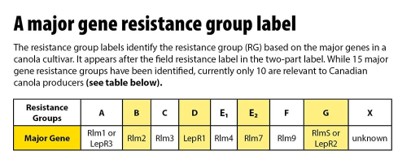
For example, if your inferred race profile is Avr 5, 9, 10:
- Review the resistance group table (above) to find a group containing a corresponding resistance gene from your sample.
- In this example, Avr9 corresponds to the resistance gene Rlm9, which is found in Resistance Group F.
- Choose a canola variety with Resistance Group F.
Clubroot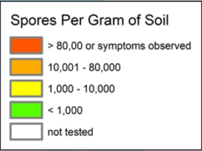
Clubroot is reported by spore load (spores of clubroot per gram of soil), and spore load category. Visual symptoms are related to the spore load in the soil, and typically appear at 80,000 spores per gram of soil. Pathotypes are currently not reported.
Using Your Clubroot Results
If spores are detected, reduce spread to other fields by sanitizing equipment between fields. Spore load can decrease over time with proper management, by lengthening crop rotation, growing clubroot-resistant varieties and controlling weed hosts (volunteer canola, wild mustard, stinkweed). No single resistant variety is guaranteed to work in every field, and there is no testing available to farmers yet to identify pathotypes within a field. Rotate between first- and second-generation resistant varieties if clubroot has been detected on your field.
Canola Diagnostics testing provides information that isn’t always visible from field symptoms alone. The results can identify disease risks, evaluate whether current management strategies are working, and support decisions around variety selection, crop rotation and sanitizing practices. Using Canola Diagnostics results as part of your planning process can help reduce disease pressure and make management decisions more effective.
For additional questions around interpreting diagnostic reports contact:
Lindsey Brooks
Agronomy Specialist
Manitoba Canola Growers
(204) 903-6509
Lindsey@manitobacanola.com
Additional Resource: